Karate in Sunningdale Area
Karate is one of the largest martial arts in South Africa, with over 200,000 active practitioners across more than 1,400 clubs. The country features a highly organized, nationwide network of traditional and competitive dojos spanning multiple disciplines. There are dojo,s that have long traditional karate lineage ties. Other dojo`s are only sport orientated and the there are dojo,s doing well with no lineage, but excel in sport and traditional karate..
National Structure and Styles
South Africa embraces a wide variety of karate styles. While there are many systems, the most prominent include: [1]
-
- Shotokan: Highly popular, with major governing bodies like SA JKA Karate, JKS Karate South Africa, and the South African Shotokan Karate Academy.
- Goju-Ryu: Promoted by prominent groups such as Shoshinkai, Seiwakai, Gojukai, OGKK
- Shito Ryu – Shukokai,
- Full-Contact Styles: Kyokushin and styles utilizing the Sabaki method, like Ashihara Karate South Africa.
Nationally, the official World Karate Federation (WKF) custodian has historically been Karate South Africa (KSA). However, the sport has recently been marred by organizational turbulence; the WKF suspended KSA’s national executive due to governance issues. A new temporary management team has been placed in charge, till the election of a NEW Governing body
_________________________________________________________________________
SHOSHINKAI GOJU RYU
Founded by Peter Klipfel 7th Dan Kyoshi in 2025
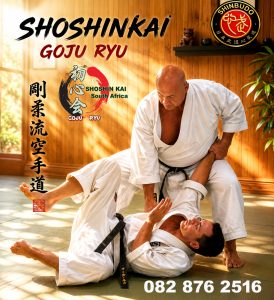
We have a strong lineage, stemming from Shotokan, Okinawan Goju Ryu, IKGA Goju Kai, Seiwakai. Training involves sound karate tuition that is both tough and yet intellectual.
Shoshinkai has dojo,s across South Africa, as well as in Botswana-Mozambique-Algeria-India
Colour belts and Dan grades are internationally approved. The class involves many training methods that improve your mind and body.
See the following
_________________________________________________________________________
Local and Community Impact
Karate plays a significant role in South African local communities, particularly in townships and rural areas where development clubs aim to keep youth off the streets. Many local dojos operate as vital community centers focusing on physical fitness, tolerance, and character building..
Today most dojo`s are dominated with more children as sport karate seems to attract the kids of today..
Not all karate dojo,s are sport inclined – Some prefer adults only and follow the Budo way that is not sport, but rather concentrated on becoming a better fitter person, mentally and physically
 Contact 082 876 2516 or email us
 D5 Creation | Powered by: WordPress